
Martingaler LP
How the LP bootstraps from zero with no upfront capital. A summary of the relevant parts of the Martingaler whitepaper.
Why this mechanism
The LP is built on the Martingaler mechanism, designed to launch an asynchronous speculation game with no upfront LP capital and no constraints on bet size. The full whitepaper walks through the theory; this page captures the parts directly relevant to this protocol.
Traditional onchain speculation games need an LP pool seeded upfront. That meant either centralised capital (with all the trust and incentive design that entails) or token rewards that complicated the protocol's economics.
The Martingaler mechanism removes both constraints, no initial LP, no bet-size cap, by replacing instant-payout LP economics with a payout queue.
The payout queue
Instead of holding an LP that pays winners on demand, the protocol routes every winning wager through a FIFO queue. The protocol can be temporarily insolvent on aggregate, but every winner gets paid in order as soon as solvency permits.
Per-wager logic:
- A new wager is placed and wins.
- If a queue already exists:
- Add the wager to the back of the queue.
- Evaluate whether the front of the queue can now be paid out (per the solvency ratio).
- If yes, pay it out.
- If no queue exists:
- Evaluate whether this wager can be paid out directly.
- If yes, pay it. Otherwise, start a queue of length one with this wager.
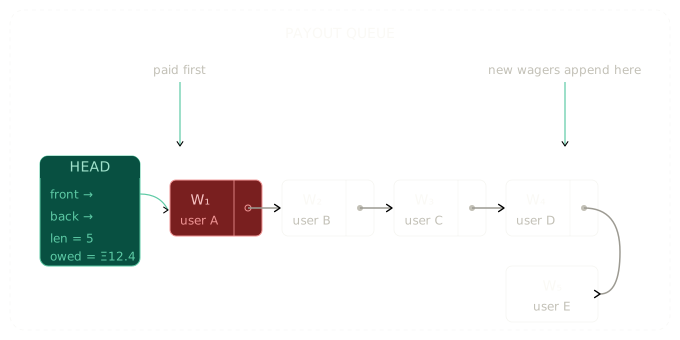
Each box is one unpaid winning wager. Harvest fires whenever the protocol can pay the front, draining payouts in order. The queue absorbs variance that an LP couldn't have absorbed on its own. Multiple front-of-queue payouts can fire per new wager when solvency allows. Losing wagers go directly to treasury; they don't interact with the queue.
Why token emissions help
Token emissions let a positive-house-edge game present as +EV for the player by remunerating them with a liquid token the moment they lose. Early participants, who carry the most variance risk, are rewarded most.
For this protocol, this is implemented as the $BET mint curve: 100 $BET per $1 of LP gain while the LP is below $2M (the flat region, including underwater), then decaying asymptotically past that point. The flat-region rate is what makes early trading attractive even before the LP becomes solvent.
$BET mint curve
The flat-then-ratchet curve that turns LP gain into $BET supply. Early activity mints at a constant rate including from underwater LP; later activity mints asymptotically less.
$BET overview
$BET is the protocol's native token. It captures a share of LP revenue and is minted to traders against losing coupons.